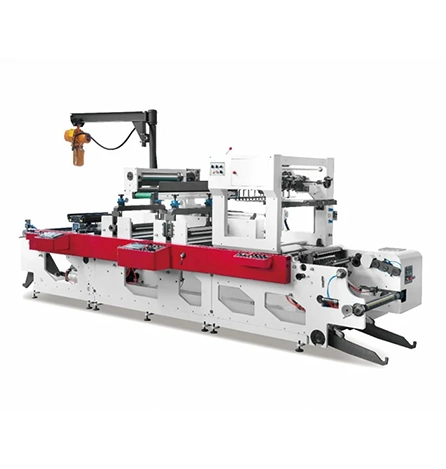
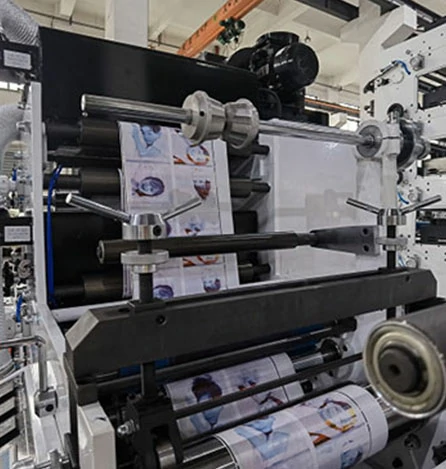
A converter in Shenzhen ran a job for a high‑end bottled water brand. The label required eight colors, including a fine registration mark that had to land within a human hair‘s width of the die‑cut window. On an older mechanical‑gear press, the label would drift after 500 meters. The operator would stop, adjust, restart, and watch the drift return. The new machine – a label flexo printing machine built around a double‑servo architecture – ran the entire 50‑kilometer roll without a single registration correction. The mark stayed where it was supposed to stay.
At 200 m/min, a 0.05 mm registration error on the first color multiplies across eight stations. The SFLEX series addresses this with double servo motors on each printing station. Each unit has its own drive, controlled by a centralized servo system, so the plate cylinder speed is locked to the web speed. The mechanical print length of the plate cylinder is fixed at a constant value, eliminating the cumulative gear backlash that causes color‑to‑color drift. This guide explains how the servo architecture maintains ±0.1 mm registration at 200 m/min, why the plate‑cylinder design simplifies changeover, and how integrated die‑cutting and finishing turn a roll of label stock into a finished product in one pass.
Conventional gear‑driven flexo presses link all printing units to a common main drive shaft through gears. Gear wear, backlash, and temperature expansion cause small but cumulative registration errors. By the eighth color, a 0.02 mm error at station one has grown to 0.16 mm, enough to turn a fine line into a blurred edge.
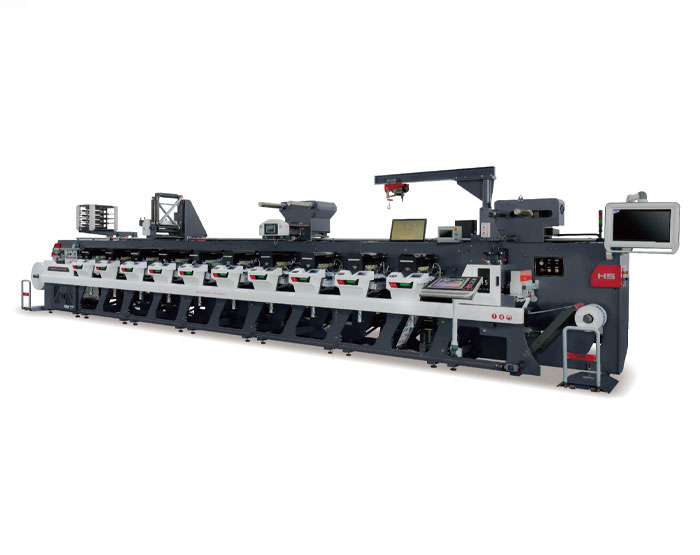
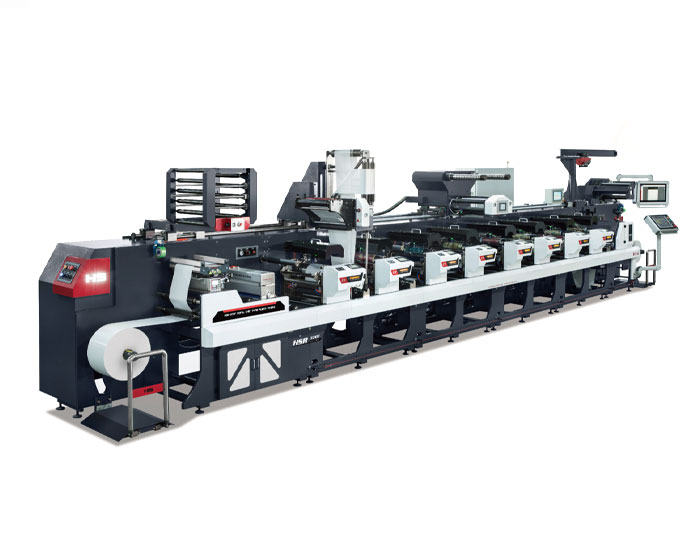
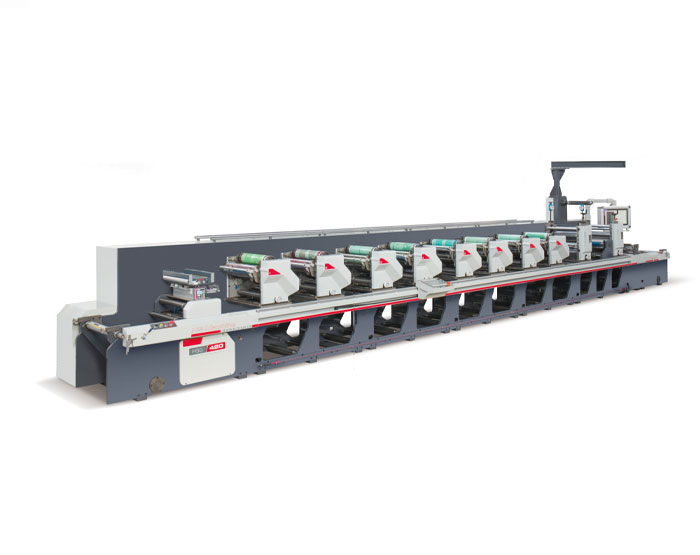
The SFLEX‑370/450/530/660 label flexo printing machine uses double servo motors for each printing station. Each station operates independently, and the servo drive adjusts the plate cylinder position on‑the‑fly using encoder feedback from the web. When the press accelerates from 0 to 200 m/min, each station tracks the web speed independently rather than following a fixed mechanical ratio.
In a gear‑driven press, changing the print length requires swapping gears, a process that can take 30‑45 minutes per station. On a double‑servo press, the operator enters the new print length into the HMI. The servo motors rotate the plate cylinders accordingly, and all stations adjust simultaneously and automatically, reducing changeover time to under 20 minutes for a full 8‑color setup.
The SFLEX-660 label flexo printing machine has a maximum mechanical speed of 200 m/min and a printed registration accuracy of ±0.1 mm. At that speed, the press produces roughly 12,000 running meters per hour. On a 10‑kilometer roll of self‑adhesive label stock, a ±0.1 mm tolerance means that over 50,000 label repeats, the total registration drift stays under ±0.1 mm. The customer does not see a shift in the logo position across the pallet.
The UV label flexo printing machine achieves this precision even on thin, stretchable films by using a servo control system where each unit is driven by one servo motor to ensure accurate registration during high‑speed running. The mechanical print length of the plate cylinder is fixed at a constant value, and the entire machine is servo‑controlled to maintain stability regardless of substrate variation or acceleration.
[Image: Double‑servo printing station on the SFLEX label flexo printing machine, showing independent motors at the plate cylinder and anilox roll, with the HMI control panel displaying real‑time registration parameters]
The SFLEX platform is offered in web widths of 370 mm, 450 mm, 530 mm, and 660 mm. A 370 mm line handles small‑format pressure‑sensitive labels, pharmaceutical carton inserts, and cosmetic decals. The 660 mm width opens up mid‑web packaging applications: shrink sleeves for beverage bottles, wraparound labels for food jars, and flexible packaging films that feed into vertical form‑fill‑seal lines.
| Model | Max Web Width | Max Print Width | Mechanical Speed | Plate Cylinder Range |
|---|---|---|---|---|
| SFLEX‑370 | 370 mm | 340 mm | 200 m/min | 8″–20″ |
| SFLEX‑450 | 450 mm | 420 mm | 200 m/min | 8″–20″ |
| SFLEX‑530 | 530 mm | 500 mm | 200 m/min | 8″–20″ |
| SFLEX‑660 | 660 mm | 630 mm | 200 m/min | 8″–20″ |
The plate cylinder repeat range of 8 to 20 inches allows the press to handle most standard label lengths without changing gear sets. The design uses the same interchangeable plate cylinder tooling across all four width models.
A label flexo printing machine that must switch between self‑adhesive paper, BOPP film, and metallized foil needs consistent surface tension and web tension control for each material. The SFLEX platform includes a web handling system with:
Corona treater to raise surface tension on non‑porous films before the first printing station.
Servo‑driven infeed and outfeed with closed‑loop tension control that adjusts torque as the roll diameter changes.
Chiller rollers on unsupported films to prevent heat deformation from UV drying lamps.
The press prints on self‑adhesive paper, PET, BOPP, PVC, shrink films, metallized paper, and aluminum foil, covering the label materials used in food, beverage, pharmaceutical, and personal care packaging.
A label that is printed, die‑cut, and rewound in one operation eliminates a handling step that costs time and scrap. The SFLEX machine integrates:
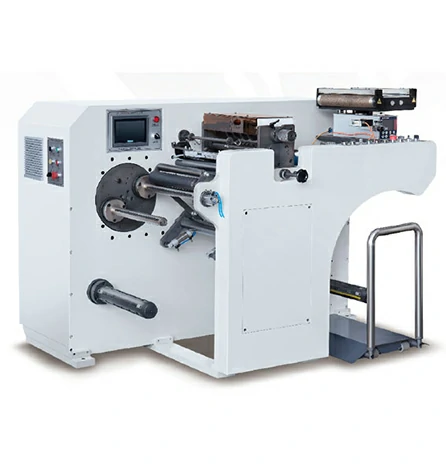
Rotary die‑cutting stations after the last printing unit, with an adjustable anvil cylinder for tool‑free repeat measurement.
Laminating unit for applying clear overlaminate to protect printed labels from moisture and abrasion.
Cold foil unit for metallic effects without a dedicated foil stamping press.
Turret rewinder for finished rolls up to 1050 mm diameter, with automatic roll change at full speed.
The three‑roller die‑cutting station is designed for quick changeover: the operator slides out one die, slides in the next, and the servo drive adjusts the angular positioning automatically based on the print length stored in the job recipe.
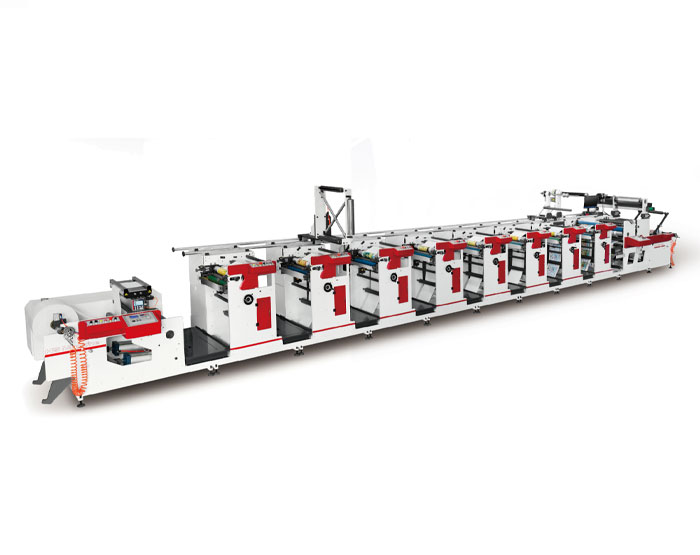
The production manager of a label converter running a legacy gear‑press accepted that fine registration marks would need an operator adjustment every hour. A run of 10,000 labels required five stops. On the SFLEX double‑servo press, the first run of fine‑register pharmaceutical labels went 10,000 meters without a single manual adjustment. The ±0.1 mm spec held from the first meter to the last. The maintenance call for gear backlash was eliminated entirely.
When the plant switched from paper to BOPP film, the UV drying lamps heated the substrate enough to stretch it, causing registration drift at the die‑cutting station. The manager enabled the optional chiller rollers between print units. The rollers kept the film at a stable 25 °C, and the registration held. The lesson: thin films need temperature stability as much as web tension stability.
On a gear‑press, each print length required a unique gear set, and the plate cylinder diameter was fixed by the press architecture. On the SFLEX double‑servo press, the operator changes the print length by programming a new value into the servo controller. A single set of plate cylinders, each engraved with a different circumference, covers the entire 8‑20 inch repeat range. The plant reduced its plate cylinder inventory from hundreds to dozens, freeing up floor space and capital.
Hongsheng Machinery has manufactured flexographic printing equipment for labels and flexible packaging since its founding. The SFLEX‑370/450/530/660 horizontal label flexo printing machine is their servo‑driven inline platform, combining high‑speed printing, in‑line die‑cutting, laminating, and cold foil application in a single pass. The press is built with double servo motors for each printing station, a dual‑servo architecture that eliminates gear backlash. The mechanical print length of the plate cylinder is fixed at a constant value, and the entire machine is entirely controlled by servo drives for consistent registration at speeds up to 200 m/min.
The control system stores job recipes for repeat orders. The operator recalls the job named “8oz beverage shrink sleeve – 6 colors – cold foil”, and the press sets the web tension curve, printing sequence, die‑cut registration, and drying parameters automatically. Changeover from a 6‑color paper label job to an 8‑color film shrink sleeve job takes under 30 minutes.
For a label flexo printing machine that holds registration within ±0.1 mm at 200 m/min across eight colors, on substrates ranging from 60 g/m² paper to 12‑micron BOPP film, the SFLEX series delivers. The double servo architecture, in‑line finishing, and job‑profile recall transform a high‑speed press into a predictable, low‑waste production system.
【Request a quote from Hongsheng Machinery】
Contact Hongsheng with your label stock type (paper, film, or foil), maximum web width, and desired number of print colors for a SFLEX configuration recommendation.
GET A QUOTE

 English
 Español
 عربي
عربي