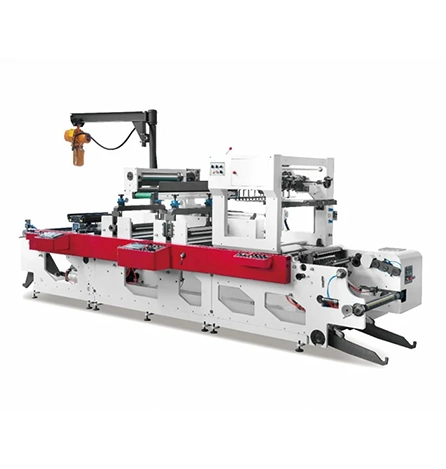
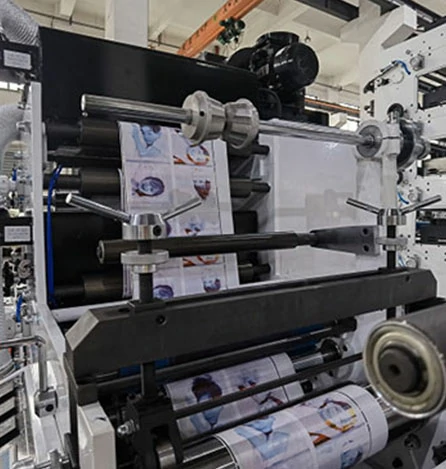
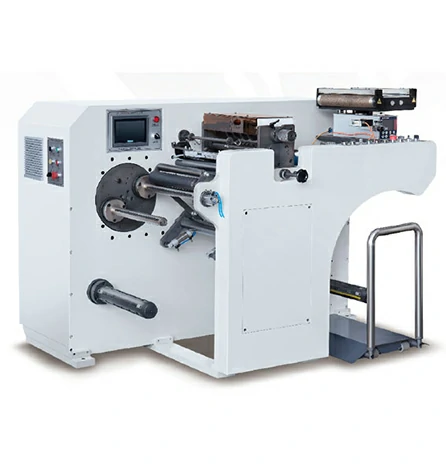
A label converter in Poland had a recurring problem with a 6‑color mechanical press. The machine would print fine for 2,000 meters, then the registration would start drifting. The operator would stop the line, tweak the register knobs, and restart. Each drift added 15 minutes of downtime. The issue wasn't the operator; it was the gear‑driven mechanical drive system, which drifted as components heated up.
The CFLEX‑340‑8C‑S uses a single servo main motor with multi‑axis servo control for all driven components. The press has a single main drive motor, but each printing unit's tension roller and anilox drive are independently controlled by slave servos. When the web speed changes, the master drive adjusts, and all slave axes follow within milliseconds. The registration, held at ±0.1mm at 150m/min, stays locked throughout a shift because the servo control system compensates for thermal expansion and mechanical wear in real time.
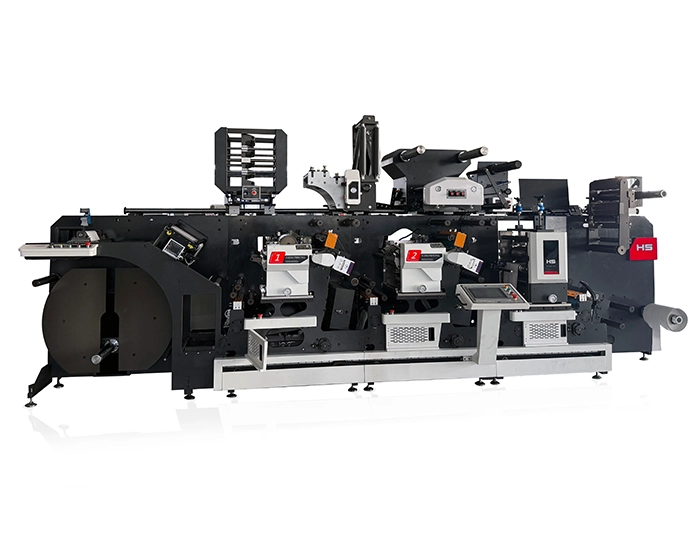
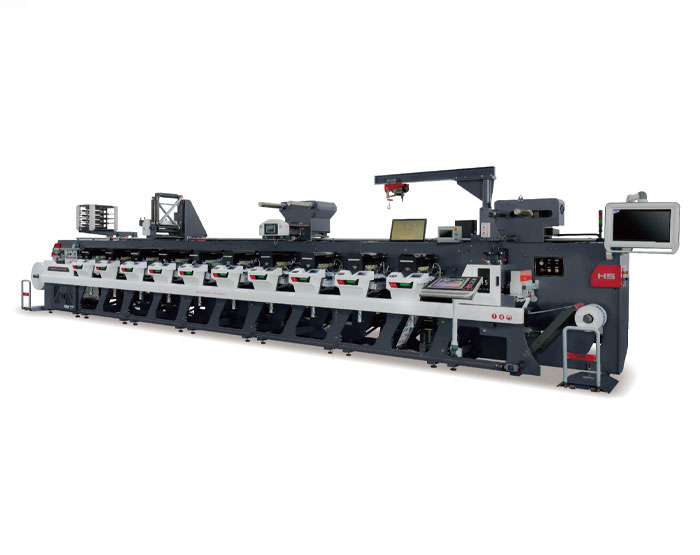
A label flexo printing machine that holds register at high speed without operator intervention reduces scrap, shortens setup time, and lowers the skill level required to run it. The CFLEX‑340‑8C‑S is an 8‑color inline flexographic label press with a maximum printing speed of 150m/min, a maximum web width of 350mm, a maximum printing width of 340mm, and unwind and rewind diameters up to 1050mm. It handles self‑adhesive labels, paper, and films (excluding shrink film) in thicknesses from 0.02mm to 0.35mm. This guide explains how the servo architecture eliminates the manual register knob, why the built‑in pre‑registration system cuts setup time, and where the HMI recipe storage saves 15‑20 minutes per job changeover for a label printer who runs 10 orders per day.
A conventional mechanical press has a single main motor driving a long gear train. Each printing unit is connected through a system of gears and shafts. As the gears wear, backlash develops, and registration drifts. When the operator changes the print repeat length, they must swap mechanical gear sets—a 30‑minute job per color.
The CFLEX‑340‑8C‑S uses a single servo main motor as the master drive. The master sends a reference signal to individual servo drives at each print station, unwind, and rewind. There is no gear train between stations. The slave servos follow the master precisely, eliminating the drift caused by gear wear. When the operator changes the repeat length, they enter the new value on the HMI, and the servo controllers reposition each printing cylinder within seconds without changing a single gear.
The multi‑axis servo control architecture is identical across the 8‑color configuration. Each of the eight stations has the same independent drive capability, so the press is balanced from the first print unit to the last. The servo‑driven system also provides closed‑loop tension control, constantly monitoring web tension through load cells or dancer rollers and adjusting the driven nip roll torque to maintain a constant pull. For a label running on thin 0.02mm polyester, this tension control prevents web wander and wrinkling that would cause registration drift on a mechanical press.
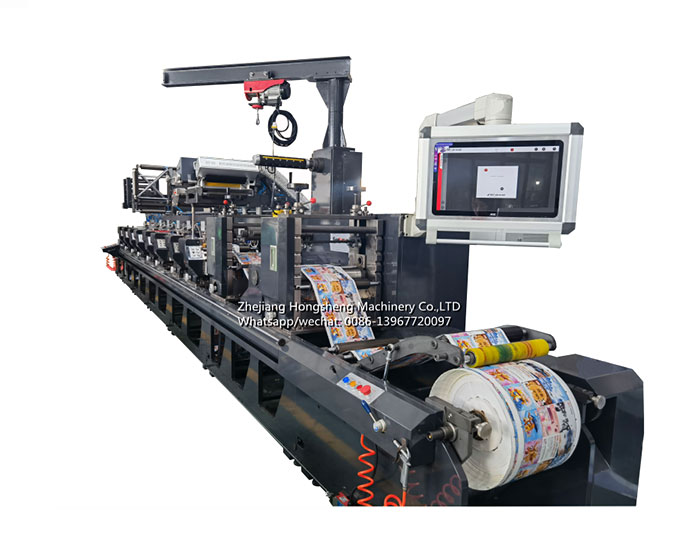
A label flexo printing machine equipped with a Datelogic color sensor performs pre‑registration before the first sheet is printed. The operator loads the pre‑printed web with registration marks, the sensor reads the mark position on each web (for multi‑web jobs) or at each color station, and the servo drives automatically position the printing cylinders to the correct angular offset. The first printed label is already in register.
The Datelogic sensor uses digital color mark detection, distinguishing between similar colors that a standard photocell would miss. For a 4‑color process label with cyan, magenta, yellow, and black registration marks printed on a white background, the sensor identifies each mark even when the mark is placed close to the image area. The response time is under 1 millisecond.
The pre‑registration system stores the sensor readings for each job. The next time the same label runs, the operator loads the film, the press recalls the saved sensor calibration, and the pre‑registration is automatic. The operator does not need to re‑teach the sensor each time.
If the Datelogic sensor fails to detect a mark where it expects one, the press stops immediately, preventing a run of misregistered labels. The operator replaces the damaged roll or adjusts the sensor position. On a mechanical press, the same condition would produce 50‑100 misprinted labels before the operator noticed and stopped the machine. For a label running at 150m/min, those 50 labels represent 12 seconds of lost production, but the scrap cost for a run of pharmaceutical labels can exceed the value of the entire job.
The CFLEX‑340‑8C‑S is equipped with 8 color printing units in a flexible configuration, meaning the printer can use fewer than 8 colors without running empty stations. A 2‑spot‑color job (e.g., red and black on white) uses two stations, and the remaining six are idle but ready for the next job. When a 6‑color process label (CMYK plus two spot colors) comes next, the operator enables all six stations, and the servo drive adjusts the web path through the press. The press configuration is stored in the job recipe.
The press supports a printing repeat range of 10″ to 24″ (254‑610mm) and uses 1.14mm plate thickness. The repeat range covers most standard label lengths, from small cosmetic labels at 6″ to large drum labels at 18″. Changing the repeat length is accomplished through the servo drives, not by changing gear sets. The operator enters the new repeat length, and the servo motors reposition the plate cylinders within seconds.
Printing on film without distortion (H3)
The press handles film thicknesses from 0.02mm to 0.35mm. For thin 0.02mm clear BOPP, the web has low bending stiffness and is prone to wrinkling. The closed‑loop tension control system automatically reduces web tension when running thin film and increases it for thick 0.35mm paper. The operator does not need to adjust tension by trial and error.
A label flexo printing machine that lacks recipe storage forces the operator to re‑enter the repeat length, print registration offsets, tension settings, and drying temperature for each job. For a 6‑color job, the setup can take 30‑40 minutes.
The CFLEX‑340‑8C‑S includes an HMI touch screen that stores complete job recipes. The operator sets up a job once—entering the repeat length, the registration offset for each color (the angular position of the plate cylinder), the web tension profile, and the temperature of each drying station. The recipe is saved under the job name. The next time the same label runs, the operator recalls the recipe, and the press sets the parameters automatically. The operator only needs to change the plates and load the correct material.
The automatic tension controller is integrated into the recipe system. When the operator recalls a recipe for a 0.03mm film job, the controller sets the taper tension profile—the curve that reduces torque as the roll diameter increases—automatically. For a 0.15mm paper job, a different profile loads. The operator does not manually adjust the tension knob.
| Parameter | CFLEX‑340‑8C‑S Specification |
|---|---|
| Colors | 8 |
| Max printing speed | 150 m/min |
| Max die cutting speed | 100 m/min |
| Max web width | 350 mm |
| Max printing width | 340 mm |
| Unwind/rewind diameter | 1050 mm |
| Printing precision | ±0.1 mm |
| Rotary die cutting precision | ±0.15 mm |
| Repeat range | 10″ – 24″ |
| Plate thickness | 1.14 mm |
| Material thickness range | 0.02 – 0.35 mm |
| Substrates | Self‑adhesive labels, paper, film (except shrink) |
How the HMI reduces operator errors (H3)
The HMI touch screen includes a parameter preset function that allows the operator to select the material type, ink type, and finish requirement before recalling the recipe. If the operator attempts to run a 0.35mm board using the tension profile for 0.02mm film, the system warns that the tension curve is out of range. The operator can override the warning or load the correct profile. For a new operator, the HMI reduces the risk of a material mismatch that would cause web break or print defect.
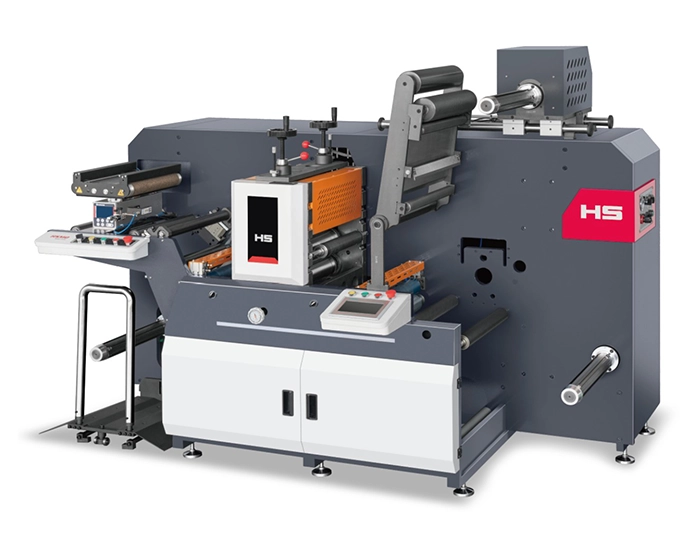
A label that is printed but not die‑cut is scrap. The CFLEX‑340‑8C‑S includes an inline rotary die cutting station with a die cutting accuracy of ±0.15mm. The die cylinder is servo‑driven and synchronized with the print cylinders. The registration mark read by the Datelogic sensor positions the die cut relative to the printed image, not relative to the web edge. For a label with a tight die‑cut window around a brand logo, the die cutting is accurate to within ±0.15mm of the logo position.
The maximum die cutting speed is 100m/min. At speeds above that, the die cutting servo cannot maintain the required dwell time for the cutting knife to penetrate the material. For a label job that requires die cutting at 150m/min, the press would stop the die cutting station and the operator would remove the printed roll to an offline die cutter—a less accurate method. The press specification matches the die cutting speed to the typical label production speed.
Rotary die cutting vs. flatbed die cutting (H3)
Rotary die cutting uses a cylindrical die that rotates against an anvil cylinder. The die is set up once and runs continuously. Flatbed die cutting uses a flat die that presses into the material, then lifts, then presses again. Rotary die cutting is faster and maintains register better for long runs, but the dies are more expensive. The CFLEX‑340‑8C‑S is a rotary press, making it suited for high‑volume label runs. For a label converter running orders of 10,000+ linear meters, the rotary die cutting precision (±0.15mm) is sufficient; for orders of 1,000 meters where die cost is amortized over fewer units, a flatbed die cutter might be more economical.
A label flexo printing machine that runs 24 hours a day, 7 days a week, must maintain print quality without operator intervention between shift changes. The CFLEX‑340‑8C‑S is designed for continuous operation with automatic tension controller that compensates for roll diameter changes as the unwind roll shrinks and the rewind roll grows. At the beginning of a roll, the unwind motor must apply low torque to avoid stretching the film. At the end of the roll, the same motor must increase torque to keep the web tension constant as the roll diameter decreases. The automatic tension controller does this without operator adjustment.
The intelligent HMI touch screen stores the tension taper profile for each material. When the operator loads a new roll of 0.02mm BOPP, the controller loads the taper curve and adjusts torque automatically throughout the roll. If the operator forgot to load the correct profile, the system warns before the roll starts.
The press also includes anti‑wrinkling features that are essential for continuous operation. A wrinkling web will cause registration drift and die cutting misalignment. The press has a spreader roller that stretches the web laterally to smooth out wrinkles as it passes through the printing section. For a label running on thin film, the spreader roller is set automatically based on the material thickness stored in the recipe.
The CFLEX‑340‑8C‑S has a maximum unwind diameter of 1050mm. A 1050mm roll of 0.08mm self‑adhesive label stock contains approximately 10,000 linear meters of material. At 150m/min, a roll lasts about 67 minutes. In a 3‑shift operation, the operator must change rolls approximately 7 times per shift. The 1050mm capacity reduces the frequency of roll changes compared to a 600mm machine, which would require changes every 45 minutes. For a label converter running 24 hours, that reduction can save 3‑4 hours of downtime per week.
Hongsheng Machinery has manufactured flexographic printing equipment for the label industry. The CFLEX‑340‑8C‑S is an 8‑color inline flexographic label press with a single servo main motor and multi‑axis Yaskawa control, delivering ±0.1mm printing precision at 150m/min. The press includes a pre‑registration Datelogic color sensor, rotary die cutting with ±0.15mm accuracy, HMI touch screen with recipe storage for quick changeover, automatic tension controller with anti‑wrinkling for 24/7 continuous operation, and handling of self‑adhesive labels, paper, and films (excluding shrink film) in thicknesses from 0.02mm to 0.35mm.
A label flexo printing machine that holds register at 150m/min with ±0.1mm accuracy, changes over jobs in minutes using stored recipes, and runs 24 hours a day with automatic tension control keeps a label production line flowing without operator intervention. For a converter who prints short‑run custom labels for the food and pharmaceutical markets, the CFLEX‑340‑8C‑S delivers the automation that reduces setup waste, eliminates registration drift, and keeps the die cutting station in register.
【Request a quote from Hongsheng Machinery】
Send Hongsheng your maximum label width (up to 340mm), substrate type (self‑adhesive paper, film, or paper), and number of colors required to receive a CFLEX‑340‑8C‑S configuration recommendation and a sample job changeover video.
GET A QUOTE

 English
 Español
 عربي
عربي