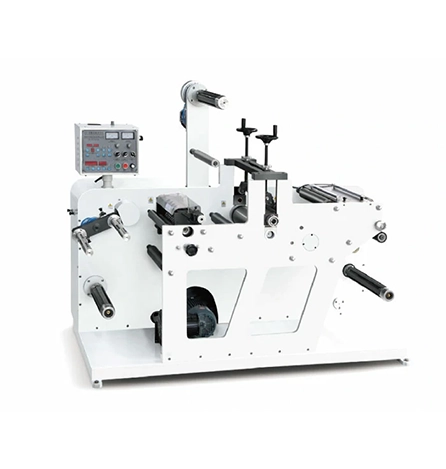
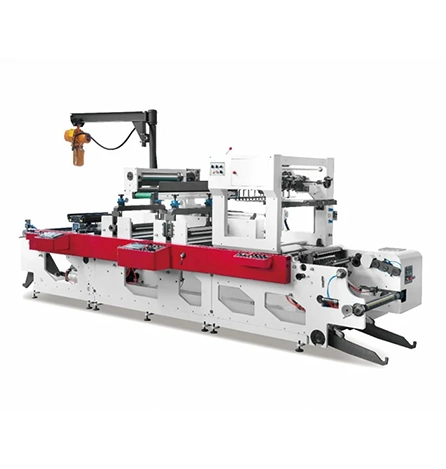
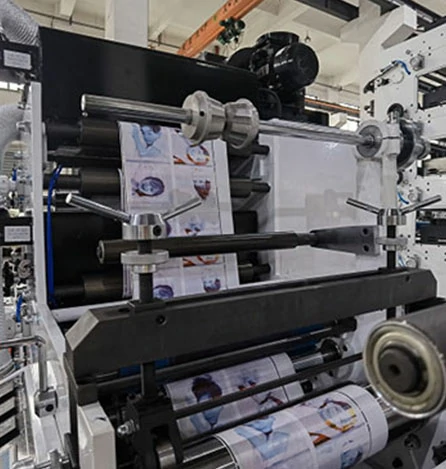
In this guide, we’ll walk through how this machine operates — from unwind to rewind — what substrates it handles best, and the trade-offs compared to CI flexo presses. We’ll also cover daily setup parameters, common problems and fixes, and a checklist for buyers. By the end, you’ll know whether a stack press belongs on your floor.
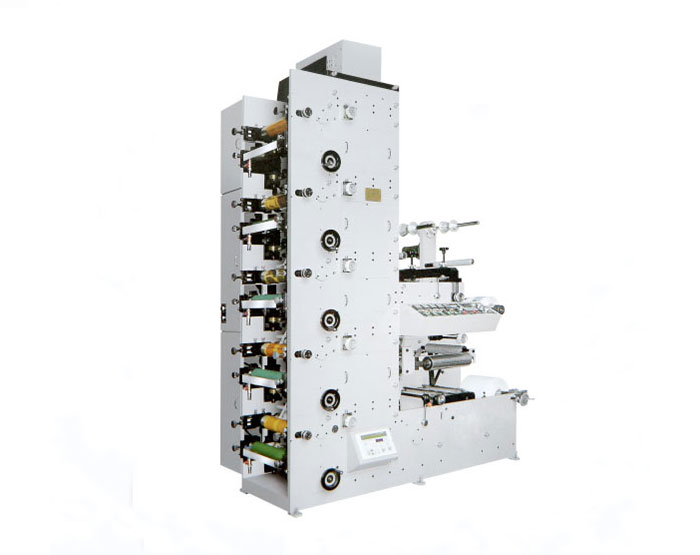
The machine uses a vertical stack of independent printing units. Each unit contains its own plate cylinder (holding the flexible relief plate), an anilox roller (metering ink), and an impression cylinder (pressing the substrate against the plate). The web — paper, film, or foil — travels straight up (or down) through each station, picking up one color at a time.
Between units, hot air or infrared dryers cure the ink immediately. This interstation drying is critical. Without it, wet ink from the first color would transfer to the next plate, causing ghosting and smears. On a 6‑color press, you might have five drying sections — one after each color except the last.
[Image: side diagram of a stack flexo press showing paper web traveling vertically through four stacked printing units with drying sections between each]
Here’s what happens step by step. The unwind section feeds the roll into the press with closed‑loop tension control. Load cells measure actual tension and adjust the brake or drive motor instantly. Too much tension stretches the web; too little causes wandering and wrinkling.
The web then enters the first printing unit. The anilox roller picks up ink from the chambered doctor blade system — a closed design that prevents solvent evaporation and maintains consistent viscosity. The anilox transfers a precise film of ink onto the relief plate. The plate contacts the substrate with just enough pressure to transfer the image. That “kiss impression” is the heart of flexography.
After printing, the web passes through a drying section. For water‑based inks, hot air at 40–60°C evaporates the water. For UV inks, high‑intensity lamps instantly polymerize the ink. The process repeats at each color station.
Finally, the rewind takes up the finished roll. Some presses include an optional slitting station right before rewind, cutting the wide roll into multiple narrow rolls ready for labeling machines.
Unlike a CI press where all colors print around one large drum, each station here runs independently. Need to skip a color for a specific job? Just disengage that unit. You can’t do that on a CI press without stopping the whole line. This independence also means you can run different plate materials or ink types on different stations — something impossible on a CI.
Stack flexo presses excel on flexible, roll‑fed materials. The Hongsheng machine series runs these with consistent results:
Self-adhesive labels (2 to 6 colors) — for consumer goods, logistics, and industrial marking.
Paper cups and paper bags — food service and retail packaging.
Food wrappers — burger papers, candy wraps, butter papers, and quick‑service restaurant packaging.
Flexible packaging films (PE, BOPP, PET) — for snack bags, frozen food pouches, and flow wraps.
Aluminum foil — for pharmaceutical blister packs and food packaging lids.
Stack presses are also popular for printing on kraft paper used in e‑commerce mailers, and on silicone‑treated release liners for label stock. The open architecture allows easy threading of delicate materials.
Rigid materials like folding carton board are out. Stack presses are designed for roll‑to‑roll printing — they cannot handle pre‑cut sheets or thick, non‑winding stock. If your primary work is corrugated or heavy paperboard, look at sheet‑fed offset or flatbed die‑cutting instead.
Also, very thin films below 12 microns (like capacitor films or ultra‑lightweight packaging) run better on CI presses, where the central drum stabilizes the web. Stack presses can run them, but you’ll need low tension and careful setup.
The choice between stack and CI comes down to substrate mix, speed requirements, and floor space. Here’s a detailed comparison:
| Feature | Stack Flexo | CI Flexo |
|---|---|---|
| Layout | Units stacked vertically | Units around a central drum |
| Registration accuracy | Good (servo-driven improves it) | Excellent (drum holds web steady) |
| Best substrates | Paper, film, foil, board (stiffer materials) | Thin, stretchy films (PE, PP, stretch wrap) |
| Typical speed | 100–300 m/min | 300–600 m/min |
| Floor space | Compact (vertical height) | Large footprint (horizontal spread) |
| Initial cost | Lower (40–60% of CI) | Higher |
| Changeover time | Moderate (20–40 min) | Longer (45–90 min) |
| Drying between colors | Yes (interstation dryers) | Yes (larger dryers, more efficient) |
| Best for | Labels, bags, cups, mixed short/medium runs | High-volume flexible packaging (pouches, shrink sleeves) |
Older stack presses from the 1980s and 1990s had a bad reputation for registration drift. Each printing unit had its own mechanical gear train, and backlash in the gears accumulated from one unit to the next. The web also stretched differently at each nip point.
Modern stack presses have solved this. Electronic shaft (servo) technology — standard on the Hongsheng China Stack Printing Machine — drives each unit independently with closed‑loop position control. Encoders on each cylinder report real position back to the controller, which adjusts motor speed instantly. The result is registration accuracy of ±0.1mm at speeds up to 200 m/min — comparable to older CI presses.
Operators who run stack presses daily point to three advantages that don’t show up on spec sheets.
Easy access to each unit. The open vertical design means you can reach every color station without crawling under or around other units. Plate changes take five minutes instead of twenty. Anilox cleaning is straightforward — you can stand directly in front of the roller. When a web break happens (and it will), you can see and clear it without disassembling guards.
Small footprint. A 6‑color stack press occupies roughly 2.5 meters of floor width and 6–8 meters of length, depending on unwind/rewind configuration. A CI press with the same number of colors needs 10–12 meters of length plus space around the drum for access. If your building has height (3–4 meters) but not length, a stack press is the only way to get multi‑color printing in that space.
Double‑sided printing in one pass. Many stack presses can print both sides by routing the web up through the first set of units, over a turning bar, and back down through another set. For paper bags, two‑sided labels, or instruction sheets printed on both sides, this feature eliminates a second pass through the press — cutting labor and waste in half.
Daily cleaning of anilox rollers and impression cylinders takes 10–15 minutes per shift. Use a soft brush and anilox cleaning solution; never use metal tools that can scratch the ceramic coating.
Weekly, check drying system filters (clogged filters reduce airflow and cause ink smearing). Calibrate tension sensors with a spring gauge. Inspect doctor blades for wear — worn blades leave streaks of excess ink.
Monthly, lubricate bearings and check belt tensions. Compare registration accuracy at startup and after four hours of running — drift should be under 0.2mm. If it exceeds that, check for loose couplings or worn servo motors.
Compared to CI presses, stack machines are simpler to maintain because each unit is self‑contained. A failed component on one unit doesn’t shut down the whole press — you can bypass that unit and run with fewer colors.
Here’s a detailed setup table with starting points for common substrates:
| Parameter | Typical Range | What Goes Wrong |
|---|---|---|
| Line speed (paper labels) | 80–150 m/min | Too slow: ink dries on plate; Too fast: insufficient drying |
| Line speed (film) | 60–120 m/min | Film stretches if speed too high |
| Impression pressure | 0.05–0.15mm beyond contact | Too high: dot gain, plate wear; Too low: broken print |
| Anilox line count (solids) | 200–300 lpi, 6–8 BCM | Lower count = more ink, better opacity |
| Anilox line count (process) | 500–800 lpi, 2–4 BCM | Higher count = fine detail, risk of starvation |
| Ink viscosity (water-based) | 20–30 sec (Zahn #2) | High: poor transfer, pinholes; Low: weak color, misting |
| Ink viscosity (solvent-based) | 18–25 sec (Zahn #2) | Similar effects plus flammability concerns |
| Interstation drying temp (air) | 45–65°C | Low: smearing between units; High: ink cracking, film shrinkage |
| UV lamp power | 100–200 W/cm | Low: incomplete cure, surface tacky; High: substrate burn |
Start every job with the plate cylinder backed completely off the impression cylinder. Run the press at 30% of target speed. Gradually increase impression pressure using the micrometer adjustment (typically 0.01mm per click) until the image transfers fully — no missing dots, no voids.
Then stop. Mark that position on the gauge. That’s your baseline. For subsequent runs of the same substrate and plate, you can set the pressure directly to that mark and start printing within two minutes instead of twenty.
A common mistake: over‑impressing “just to be safe.” This crushes the plate, fills fine details, and accelerates plate wear. A flexo plate that should last 500,000 impressions might fail at 100,000 if pressure is 0.1mm too high.
Buying a stack flexo press is a significant investment. Here’s what experienced production managers check before signing.
Servo‑driven vs. mechanical drive. Servo units cost more upfront but pay back in faster setup and better registration. The Hongsheng China Stack Printing Machine uses independent servo drives on each unit — this is non‑negotiable if you run short runs or frequent changeovers.
Number of colors. Four or six is the sweet spot for most label and bag work. Order the press with that many from the start; adding stations later requires returning the machine to the factory for frame modification. It’s rarely cost‑effective.
Drying type. IR (infrared) is standard for water‑based inks and works for most paper applications. Hot air alone is slower and less efficient. UV is required for high‑gloss, chemical‑resistant, or outdoor‑durable labels. UV lamps add $15,000–30,000 per station but enable printing on films that water‑based inks won’t wet.
Roll capacity. Larger unwind/rewind diameters mean longer runs between roll changes. A 600mm roll lasts three times longer than a 400mm roll at the same line speed. If you run 24/7, pay extra for the larger diameter capacity — it cuts downtime dramatically.
Shop height. A 6‑color stack press with drying sections can stand 3.5–4 meters tall. Measure your building’s clearance before ordering. Also check crane access — you’ll need to lift anilox rollers and plate cylinders for maintenance.
Spare parts availability. Ask the supplier for a list of common wear parts: anilox rollers, doctor blades, heater elements, servo motor drives. How many are stocked locally? What’s the lead time for a replacement anilox? A two‑week wait for a 1,000partcancost1,000partcancost20,000 in lost production.
Never buy a press without running your own materials on it. Bring three representative substrates — for example, 80gsm paper label stock, 50 micron BOPP film, and 40gsm kraft paper. Run each for 30 minutes at the claimed top speed.
Watch the register at startup, after a speed change (slow down to 50% then back up), and after 30 minutes of continuous running. Ask the operator to change a plate. Time it. Ask about the most common jam point — then deliberately create a web break and see how long it takes to clear.
If the supplier hesitates to run a demo with your materials, walk away. A machine that looks perfect on a spec sheet can be a nightmare on the floor.
Even well‑maintained stack presses have issues. Here’s a troubleshooting guide based on real floor experience.
Problem: Registration drifts after 20 minutes. Likely cause: tension drifting as the unwind roll diameter decreases. Fix: Use taper tension programming — reduce tension progressively as the roll empties. If your press has open‑loop tension (just a brake), upgrade to closed‑loop with a dancer roller.
Problem: Ink smearing between units. Likely cause: insufficient drying. Check dryer temperature with a contact thermometer — screen readings can be off by 10–15°C. Clean dryer filters. Increase air flow. As a temporary fix, reduce line speed.
Problem: Poor ink adhesion on film. Likely cause: no corona treatment or low surface energy. Test with a dyne pen. Film needs 38–42 dynes/cm for water‑based ink. If it’s lower, add an in‑line corona treater before the first print unit.
Problem: Ghosting (repeating image defect). Likely cause: anilox roller too full or ink viscosity too low. Increase viscosity by adding fresh ink or running the ink pump faster. If ghosting remains, clean the anilox roller — plugged cells release ink unevenly.
Problem: Edge wrinkling on thin paper. Likely cause: misaligned rollers or uneven nip pressure. Check that all rollers are parallel within 0.05mm per meter of width. Use a nip impression test: run a strip of carbon paper through each nip and measure the width of the mark. It should be consistent across the web.
Some problems require professional help: blown servo drives (replace only, no field repair), cracked anilox ceramic (requires re‑coating or replacement), worn impression cylinder bearings (causes vibration that shows up as periodic print defects), and damaged dryer heating elements (replace with OEM parts). Keep a log of recurring issues — if the same problem appears every week despite cleaning and adjustments, it’s likely a mechanical alignment issue that needs a technician.
For many small to mid‑size converters, a Stack Flexo Printing Machine is the perfect starting point. It won’t outrun a CI press in a drag race, but it will print consistent labels, bags, and wraps at a fraction of the cost and footprint. And on a crowded shop floor, that’s what matters.
A good stack press delivers 80% of the capability of a CI press for 50% of the cost and 40% of the floor space. If you’re running paper‑based substrates, moderate volumes (under 500,000 linear meters per month), and frequent changeovers (three or more jobs per shift), the stack design is likely your most profitable choice.
【Request a quote from Hongsheng Machinery for the China Stack Printing Machine】— Share your substrates (paper, film, foil), number of colors, monthly volume in linear meters or rolls, and whether you need UV drying or double‑sided printing. Their technical team will recommend a configuration that fits your space and budget, including a live demo at their facility with your materials.
GET A QUOTE

 English
 Español
 عربي
عربي